

 Español
 عربى
product
product
product
product
product
product
product
product
product
product
product
product
product
product
product
product

Product Category
Contact us
Message Feedback
About Us
30 Years of Expertise in Automotive Fasteners
Zhejiangxinye Automobile Technology Co. , Ltd. traces its origins to 1995, evolving from Jiaxing Zhapu Xinye Standard Parts Co., Ltd. We are China Weld Nuts Suppliers and Custom
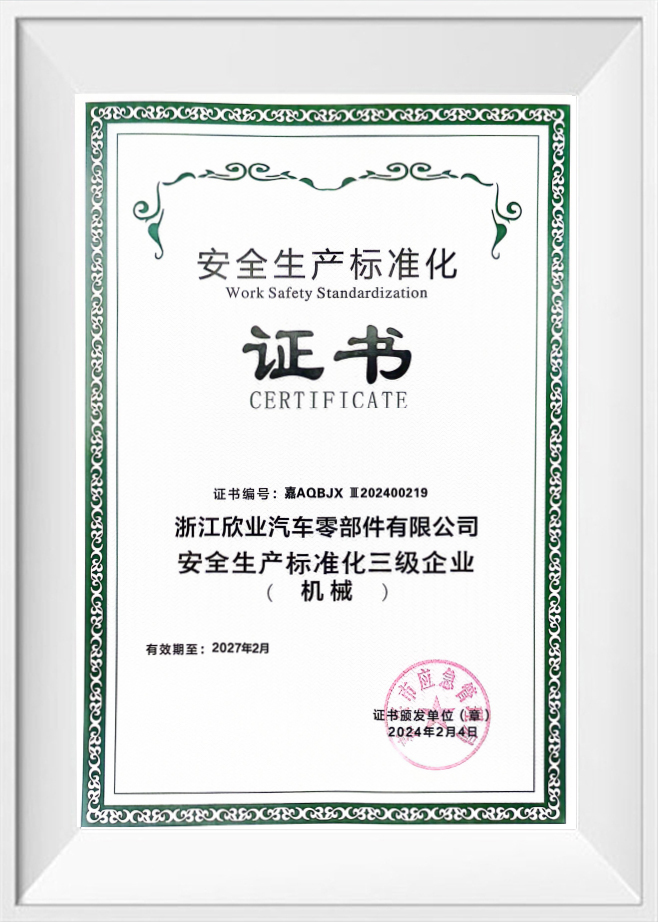
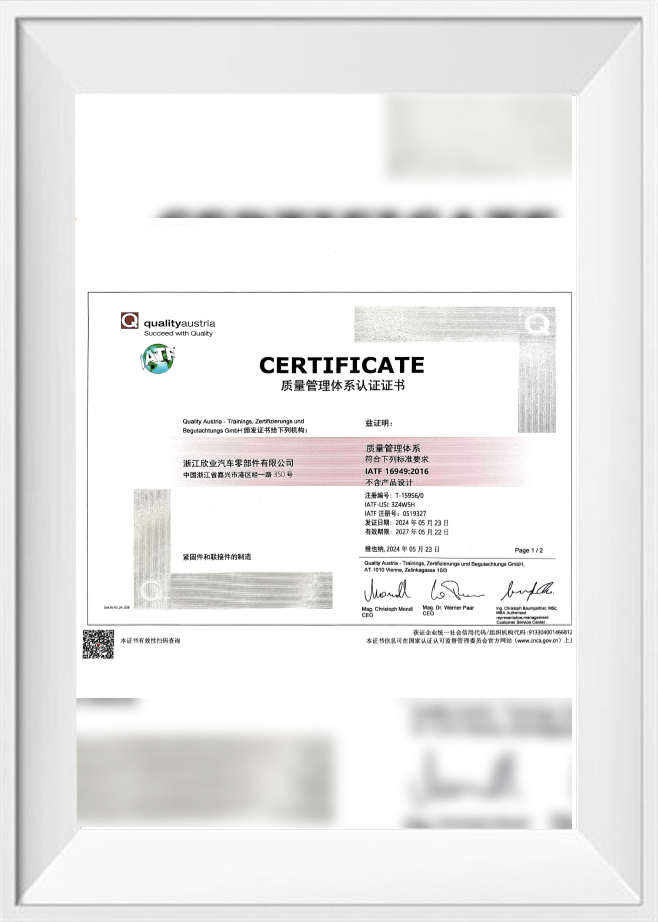
Weld Nuts factory. The company specializes in the production of various automotive fasteners and stamping parts, including flange nuts, welding nuts, and more. For over 30 years, Xinye has kept pace with industry trends, focusing on technological innovation and internal management, and has achieved steady growth. The company is now certified to IATF 16949-2016.
Adhering to the principle of "surviving by product quality, developing by technological innovation," Xinye takes quality as its foundation and customer satisfaction as a top priority, committed to providing suitable and reliable products. To enhance product competitiveness and strengthen employee quality awareness, the company has established a sound management system and standardized process flows. Work instructions have been developed for special and critical processes, and strict quality inspections are conducted at every step. From raw material analysis to finished product mechanical performance testing, process control is implemented to ensure product conformity. The continuously improving quality management system and stable product performance have earned the company market recognition, as well as customer trust and praise.
Adhering to the principle of "surviving by product quality, developing by technological innovation," Xinye takes quality as its foundation and customer satisfaction as a top priority, committed to providing suitable and reliable products. To enhance product competitiveness and strengthen employee quality awareness, the company has established a sound management system and standardized process flows. Work instructions have been developed for special and critical processes, and strict quality inspections are conducted at every step. From raw material analysis to finished product mechanical performance testing, process control is implemented to ensure product conformity. The continuously improving quality management system and stable product performance have earned the company market recognition, as well as customer trust and praise.
-
0m2
Factory Area
-
0
Brand Origin
-
0+
Product Range


Zhejiangxinye Automobile Technology Co. , Ltd.
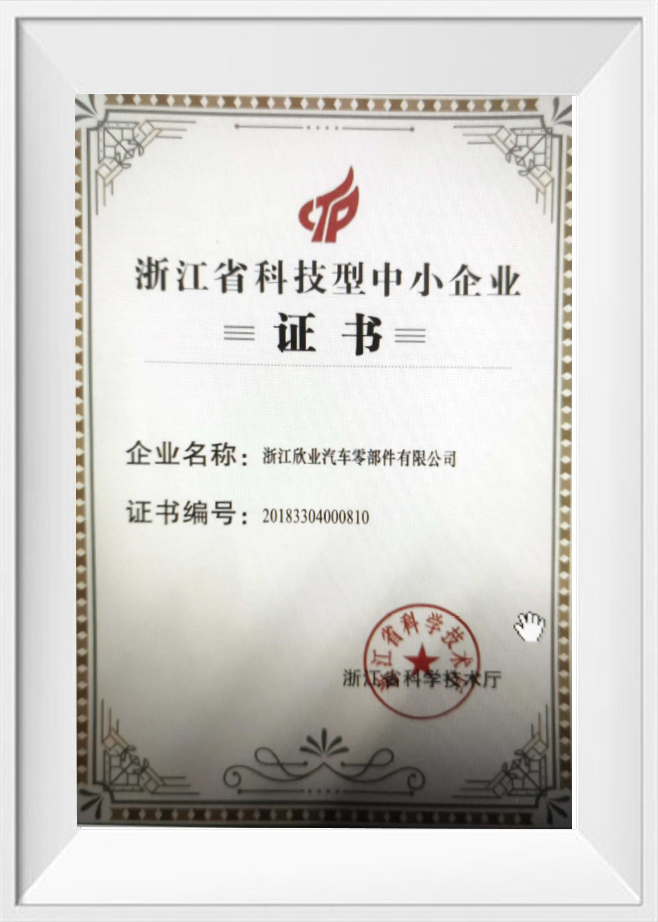
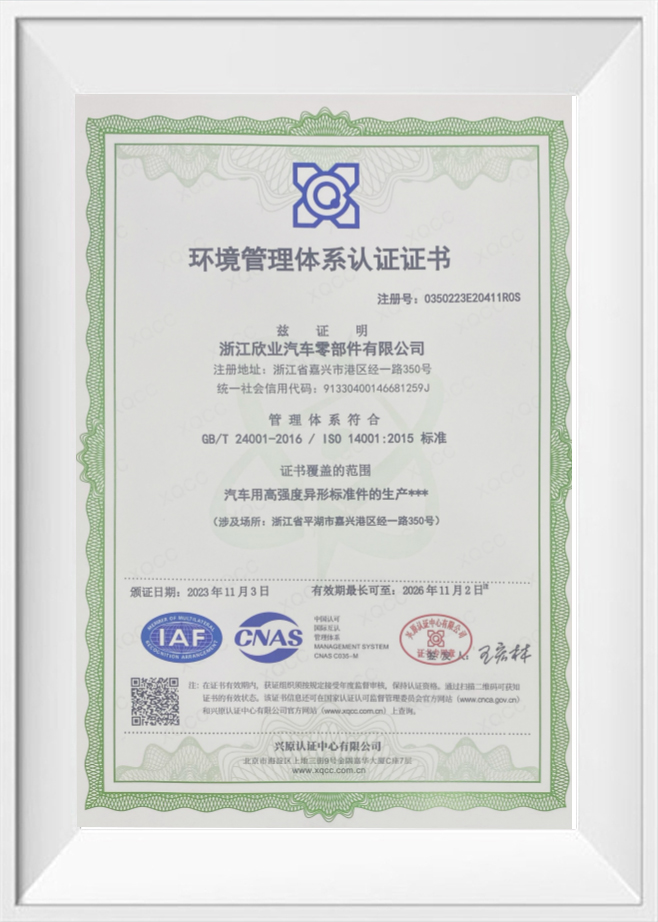
Certificate Of Honor
What’s News
Industry Insights & Updates
View All News
-
2026-11-03Industry News
-
2026-11-03Industry News
-
2026-11-03Industry News
Weld Nuts Industry Knowledge
Zhejiangxinye Automobile Technology Co., Ltd. has produced automotive fasteners and stamping parts in Jiaxing, Zhejiang since 1995, and weld nuts have run through that programme from the company's early flange nut and welded cap production. We are certified to IATF 16949-2016 and complete production in-house, from raw material analysis through cold heading, tapping, heat treatment, thread rolling and finished-part mechanical testing.
Our Custom Weld Nuts Suppliers, Exporter range covers the welded fixings called out on body-in-white, seat structure, chassis bracket and battery enclosure drawings: spot weld T-nuts, zinc-plated round weld spacers, internally threaded round weld spacers and cylindrical carbon steel welding nuts. Each type is made to the customer drawing, because flange diameter, body height, projection pattern, thread, property class and coating are decided by the joint the nut has to hold rather than by a fixed catalogue shape.
Weld Nut Types and Where Each One Fits
A weld nut gives a panel a permanent threaded anchor where the sheet is too thin to tap and a loose nut cannot be reached from behind. Selection follows the welding method, the sheet thickness, gun access at the joint and the axial load the thread must carry.
| Weld nut type | Configuration | Weld interface | Where it fits | Drawing inputs |
|---|---|---|---|---|
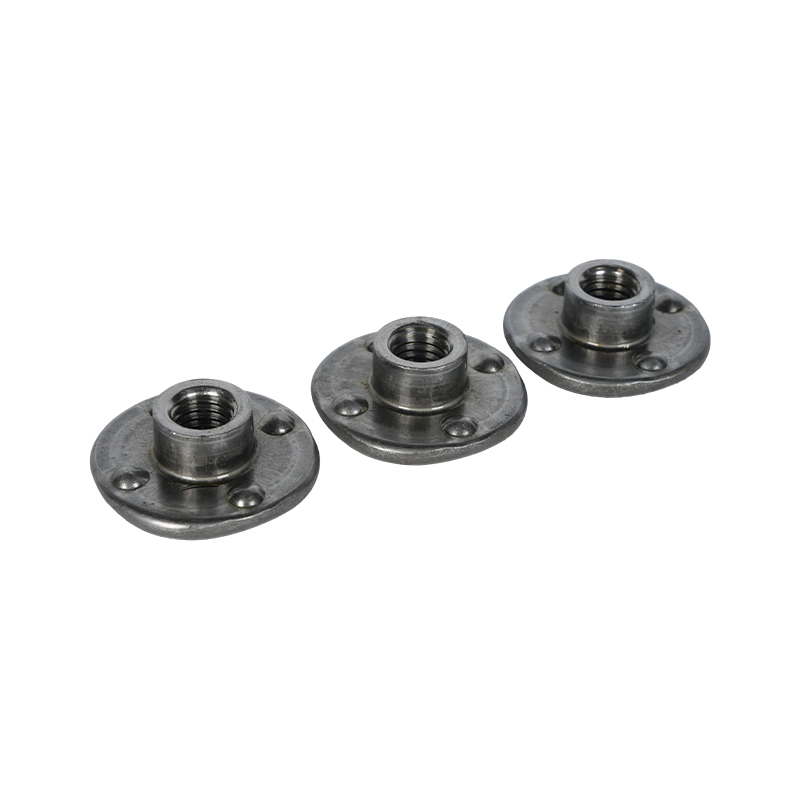
| Spot Weld T-Nut | T-body with weld projections on the seating face | Resistance projection welding to steel sheet | Deep threaded anchor inside pillars, closed sections and bracket joints where a barrel nut is difficult to place | Thread, body diameter and length, projection count and height, seating face flatness |
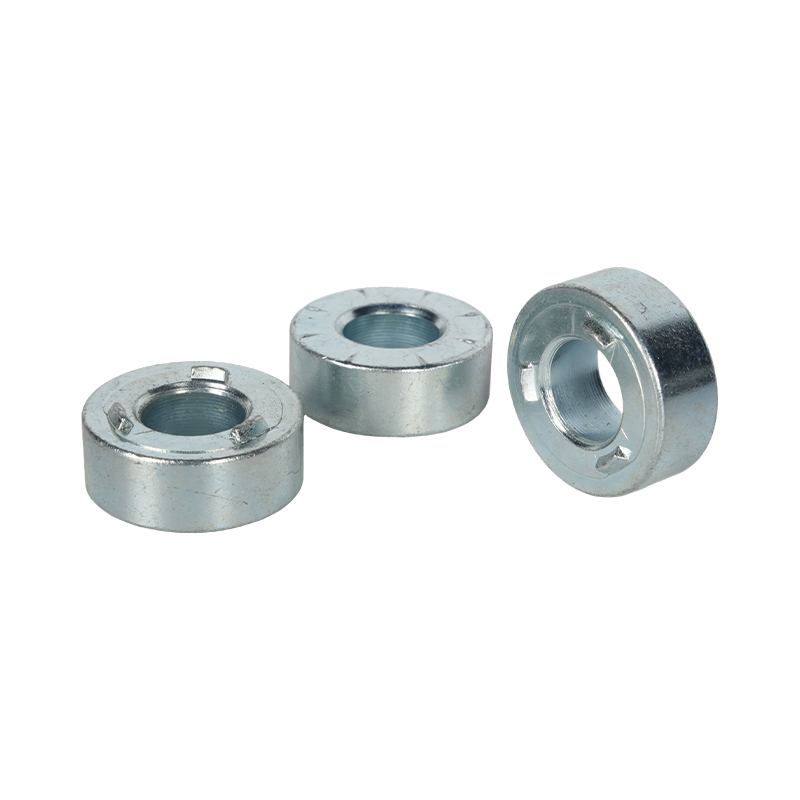
| Round Weld Spacer, Zinc Plated | Circular spacer body, zinc-plated, plain or threaded bore | Projection welding | Standoff and spacing points in brackets and panel stacks where height and general corrosion duty both matter | Outer diameter, height, bore or thread, coating thickness |
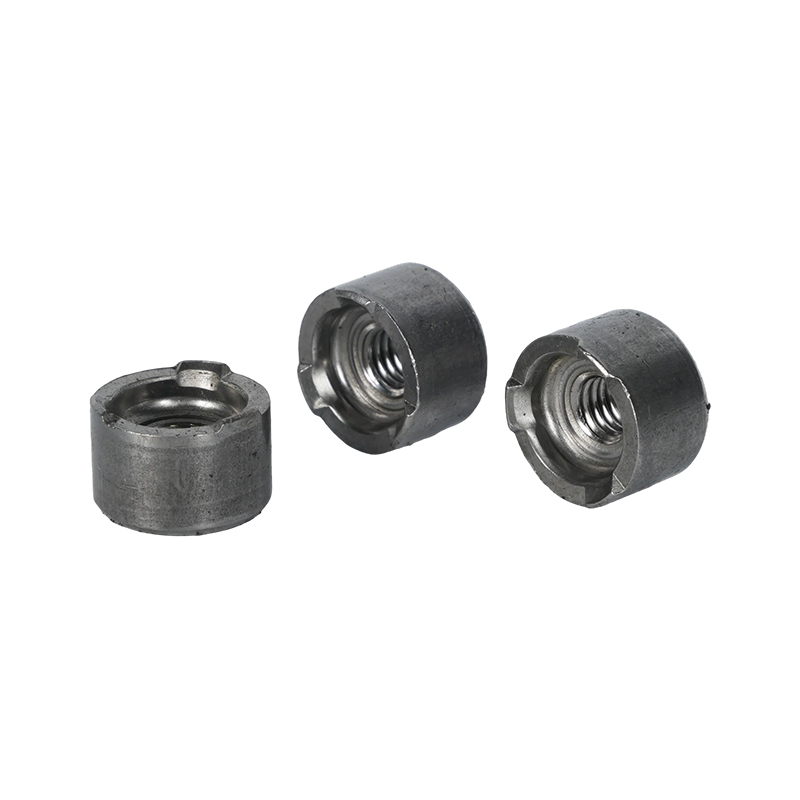
| Round Weld Spacer with Internal Thread | Cylindrical spacer with a machined internal thread | Projection welding | Threaded boss for body, subframe and seat mounting points that need a defined stack height and a square seating face | Thread class, height, pilot diameter, runout, property class |
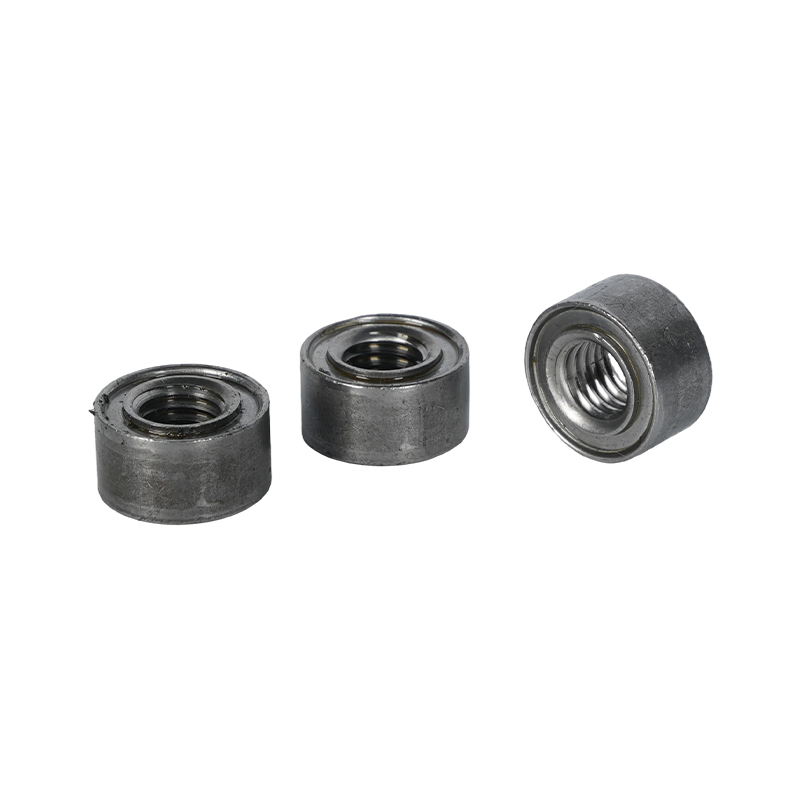
| Carbon Steel Round Welded Nut, Cylindrical Welding Nut | Cylindrical carbon steel nut with a welding flange | Projection welding | High-volume welded joints in carbon steel sheet, reinforcements and brackets with a defined flange bearing area | Flange diameter, projection geometry, property class, heat treatment |
Thread size, flange diameter and body height are confirmed against the panel drawing, and the projections are laid out for the electrode pattern of the weld gun used on the line.
Application Fit in Body, Seat, Chassis and Thermal Zones
Weld nuts are specified where the thread has to survive the life of the vehicle inside a seam that is closed after assembly. The families above map onto the main joint groups we supply.
- Body-in-white and closures: hinge, latch and bracket reinforcements in thin-gauge steel, where the nut carries the thread and the panel carries the load path.
- Seat structures: rail anchors, adjuster mounts and recliner attachments, coordinated with our seat system nuts and seat adjustment parts when the seat frame also uses non-welded fixings.
- Chassis, subframes and brackets: higher property classes for axial load, vibration and torque retention over the service life.
- Exhaust, EGR and engine periphery: 300 °C, 550 °C and 650–700 °C grades that hold preload under repeated thermal cycling.
- EV battery enclosures: our sealed nuts for EV battery pack applications cover joints where the welded seat must also restrict water ingress around the fastener.
Material, Property Class and Thread Configuration
Weldability governs the base material, while the thread and mechanical class are set by the clamp load the joint needs. Both sides are fixed before tooling is released.
- Base material: carbon steel is the standard choice for resistance welding to mild and high-strength steel sheet; other grades are reviewed against the panel they are welded to.
- Property class: capability spans Class 5/8 through Class 12, with Class 13–14 ultra-high-strength grades at pre-research stage for heavy-duty and high-performance applications.
- MAT self-correcting thread: the first threads guide a slightly misaligned bolt back into the thread path during automated assembly, reducing cross-threading stalls on the line.
- Tolerance: dimensions are held across a 0.06 mm to 0.30 mm control band according to the fit class on the drawing.
- Coating: trivalent zinc at 480 h salt spray and Zn–Ni alloy at 480–720 h, applied and checked on our own surface finishing line.
- Temperature grade: material and finish routes for 300 °C, 550 °C and 650–700 °C service in exhaust and engine-periphery locations.
Welding, Fixturing and Installation
A weld nut performs only as well as the welding window allows, so projection geometry is matched to the sheet rather than chosen from a table.
- Projection height is set so the sheet reaches fusion without burn-through across the specified thickness range.
- Flange diameter and body height are checked against gun shroud and electrode clearance at the joint before the drawing is frozen.
- The pilot or body diameter locates the nut in the panel hole, controlling position, runout and thread squareness.
- Seating face flatness and sheet angularity are held so clamp load is not lost to gap and torque readings stay consistent.
- Validation covers push-out force, torque-out, torque-tension behaviour and weld nugget cross-sections, sampled at an agreed frequency.
Quality Control and Acceptance
Our quality system is certified to IATF 16949-2016, with written work instructions for special and critical processes and inspection at every production step.
- Incoming raw material analysis covers chemistry and hardness before heading begins.
- Cold heading, tapping, thread rolling and heat treatment are each checked against the process instruction.
- Finished parts are tested for mechanical performance and hardness, with coating thickness and salt-spray verification on plated items.
- Dimensional inspection covers thread gauging, flange diameter, height, projection pitch, concentricity and runout to the drawing revision.
- Results are reviewed batch by batch before release, with records retained for traceability.
Customization, Tooling and Alternative Nut Types
Where the drawing departs from a catalogue shape, such as a wider flange, a longer body, a different projection layout, a fine thread or an alternative steel grade, we build the tooling around it. The Non-Standard Nuts range carries those welded variants alongside other made-to-print nuts from the same production system.
Where welding does not suit the panel, because the sheet is coated, thin or accessible from one side only, the Clinch Nuts range offers a press-embedded alternative. The wider Nuts range covers standard, self-locking, knurled, slotted and sliding types, all produced at our factory in Zhejiang.
Packaging, Documentation and Delivery Scope
- Inner packing protects plated surfaces and threads through container transport and manual or automated unpacking.
- Labels carry part number, drawing revision, batch, quantity and coating so receiving inspection can match the consignment to the order.
- The documentation package is agreed per order and can include material and mechanical test reports, dimensional records and the packing list.
- Carton format, quantity per box and pallet arrangement are fixed at order confirmation to suit the customer's receiving and line-feeding arrangements.
Information We Use to Configure Your Solution
A weld nut quotation is only as accurate as the joint description behind it. These are the inputs that change the tooling, the process route and the inspection plan.
| Project input | What it determines |
|---|---|
| Drawing or sample: thread, flange diameter, body height, projection geometry | Heading dies, tapping and thread-rolling setup, projection tooling |
| Panel material and sheet thickness | Projection height and the usable welding window |
| Property class or mechanical requirement | Steel grade, heat treatment route and hardness range |
| Coating and corrosion target | Trivalent zinc at 480 h salt spray or Zn–Ni alloy at 480–720 h |
| Service temperature at the joint | 300 °C, 550 °C or 650–700 °C material and finish route |
| Weld method, gun type and electrode access | Flange diameter, projection layout and body clearance |
| Annual volume and release pattern | Tooling plan and production routing |
| Inspection and documentation package | Control plan, sampling frequency and reports issued with the batch |
| Packaging, labelling and receiving requirements | Carton format, protection, label content and pallet build |
Frequently Asked Questions
Which weld nut types does Xinye produce?
Spot weld T-nuts, zinc-plated round weld spacers, round weld spacers with internal thread and carbon steel cylindrical welding nuts, plus non-standard welded variants to customer drawing. Heading, tapping, heat treatment, thread rolling and surface finishing are all carried out in-house.
Which property classes and coatings are available?
Our capability spans Class 5/8 through Class 12, with Class 13–14 ultra-high-strength grades in pre-research. Trivalent zinc is rated at 480 h salt spray and Zn–Ni alloy at 480–720 h; temperature grades of 300 °C, 550 °C and 650–700 °C cover exhaust and engine-periphery joints.
Can weld nuts be produced to our drawing instead of a standard shape?
Yes. Flange diameter, body height, projection layout, thread, material and coating are taken from the drawing, and tooling is built to that configuration before samples are submitted for evaluation on your fixture.
How is weld nut quality verified before shipment?
Under our IATF 16949-2016 system, raw material chemistry and hardness are checked on arrival, each forming and heat-treatment step is inspected against its work instruction, and finished parts are tested for mechanical performance, hardness, coating and dimensions against the drawing revision.
What information do you need to quote a weld nut?
A drawing or sample, panel material and thickness, required property class, coating and corrosion target, service temperature, weld method and gun access, annual volume, packaging and the inspection documents you expect with each batch. With these we return a configuration, tooling scope and quotation.
When is a weld nut the better choice over a clinch nut?
A weld nut suits weldable steel sheet with gun access at the joint and a thread that must sit inside a closed section. A clinch nut is the practical route where welding is not permitted, the panel is coated, or the press line can embed the fixing during forming.
- Contact Us
-
-
861260628@qq.com

zj@xy-nuts.com -
+86 15888350558

-
No.350 Jingyi Road, Jiaxing Port Area, Zhejiang Province, China.

-
- Quick Links
- Products
- About Us
- Capabilities
- Service
- News
- Contact Us
- Product
- Nuts
- CNC Machined Components, Sleeves & Pins
- Specialty & Functional Automotive Components
- Metal Stampings
- Bolts & Screws
- Mobile
Copyright ©
Zhejiangxinye Automobile Technology Co. , Ltd.
All Rights Reserved
Custom
Weld Nuts Suppliers
