

 Español
 عربى
product
product
product
product
product
product
product
product
product
product
product
product
product
product
product
product

Product Category
Contact us
Message Feedback
About Us
30 Years of Expertise in Automotive Fasteners
Zhejiangxinye Automobile Technology Co. , Ltd. traces its origins to 1995, evolving from Jiaxing Zhapu Xinye Standard Parts Co., Ltd. We are China Slotted Nuts Suppliers and Custom
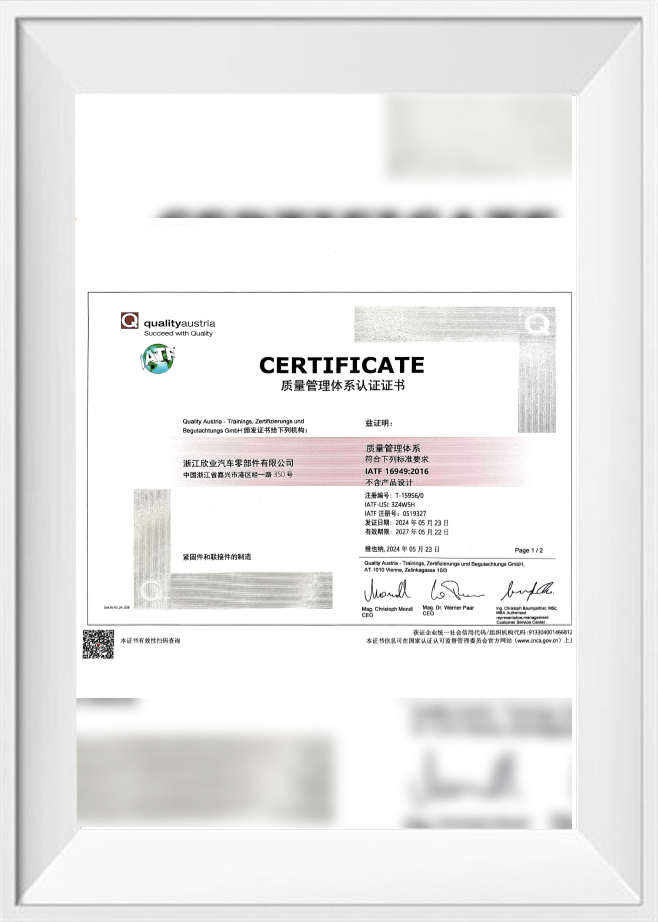
Slotted Nuts factory. The company specializes in the production of various automotive fasteners and stamping parts, including flange nuts, welding nuts, and more. For over 30 years, Xinye has kept pace with industry trends, focusing on technological innovation and internal management, and has achieved steady growth. The company is now certified to IATF 16949-2016.
Adhering to the principle of "surviving by product quality, developing by technological innovation," Xinye takes quality as its foundation and customer satisfaction as a top priority, committed to providing suitable and reliable products. To enhance product competitiveness and strengthen employee quality awareness, the company has established a sound management system and standardized process flows. Work instructions have been developed for special and critical processes, and strict quality inspections are conducted at every step. From raw material analysis to finished product mechanical performance testing, process control is implemented to ensure product conformity. The continuously improving quality management system and stable product performance have earned the company market recognition, as well as customer trust and praise.
Adhering to the principle of "surviving by product quality, developing by technological innovation," Xinye takes quality as its foundation and customer satisfaction as a top priority, committed to providing suitable and reliable products. To enhance product competitiveness and strengthen employee quality awareness, the company has established a sound management system and standardized process flows. Work instructions have been developed for special and critical processes, and strict quality inspections are conducted at every step. From raw material analysis to finished product mechanical performance testing, process control is implemented to ensure product conformity. The continuously improving quality management system and stable product performance have earned the company market recognition, as well as customer trust and praise.
-
0m2
Factory Area
-
0
Brand Origin
-
0+
Product Range


Zhejiangxinye Automobile Technology Co. , Ltd.
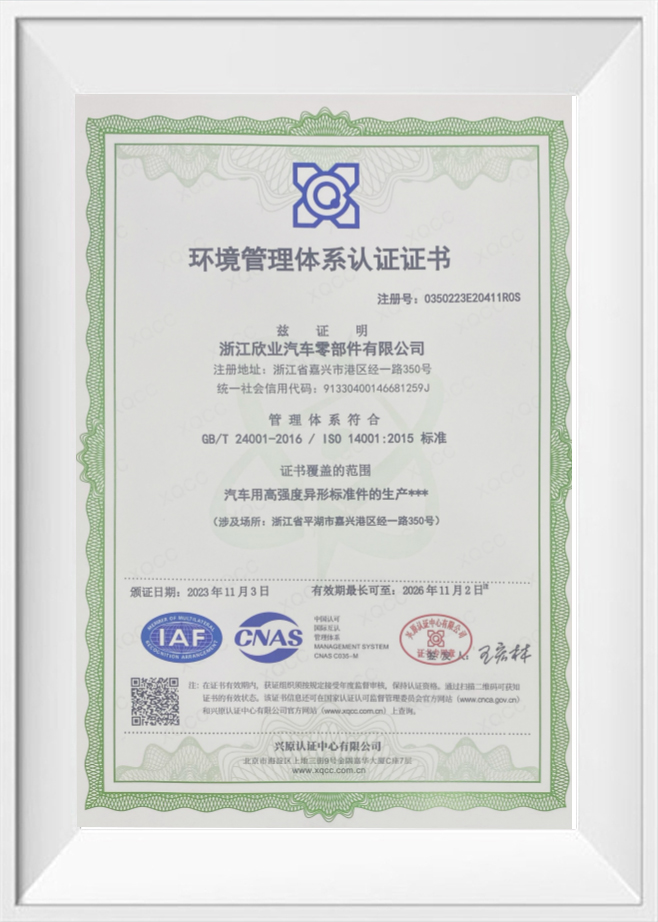
Certificate Of Honor
What’s News
Industry Insights & Updates
View All News
-
2026-11-03Industry News
-
2026-11-03Industry News
-
2026-11-03Industry News
Slotted Nuts Industry Knowledge
Zhejiangxinye Automobile Technology Co., Ltd. has produced automotive fasteners and stamping parts from its Jiaxing Port Area plant since 1995 and today works as Custom Slotted Nuts Suppliers, Exporter for wheel-end, suspension, steering and general machinery assemblies. Slotted nuts sit inside a wider nut programme covering more than 500 product varieties, produced in-house from raw material analysis through finished-part mechanical performance testing under IATF 16949-2016.
- Hexagon and hex flanged slotted bodies with machined or formed castellations
- Property class development through Class 12, with Class 13–14 ultra-high-strength nuts in pre-research
- Dimensional control across 0.06 mm to 0.30 mm tolerance bands, matched to the application
- Trivalent zinc at 480 h salt spray and Zn-Ni alloy plating at 480–720 h salt spray
- In-house cold heading, tapping, thread rolling, heat treatment and hardness testing
How a Slotted Nut Holds a Joint
A slotted nut carries castellations cut across the top face so a cotter pin, split pin or safety wire can pass through the slots and through a cross-drilled hole in the mating stud. The lock is mechanical and does not depend on prevailing torque, which is why slotted nuts are specified where vibration, thermal cycling or restricted access make re-torque impractical.
- Positive retention that remains effective after the joint relaxes under load
- Disassembly and re-assembly without destroying the thread or the locking element
- Locking condition visible at inspection — the pin is present or it is not
- Slot-to-hole alignment must be engineered into the stud and nut pairing, not forced at assembly
- Slot edges require deburring; sharp corners act as stress raisers on the pin
Our Slotted Nut Range and Configuration
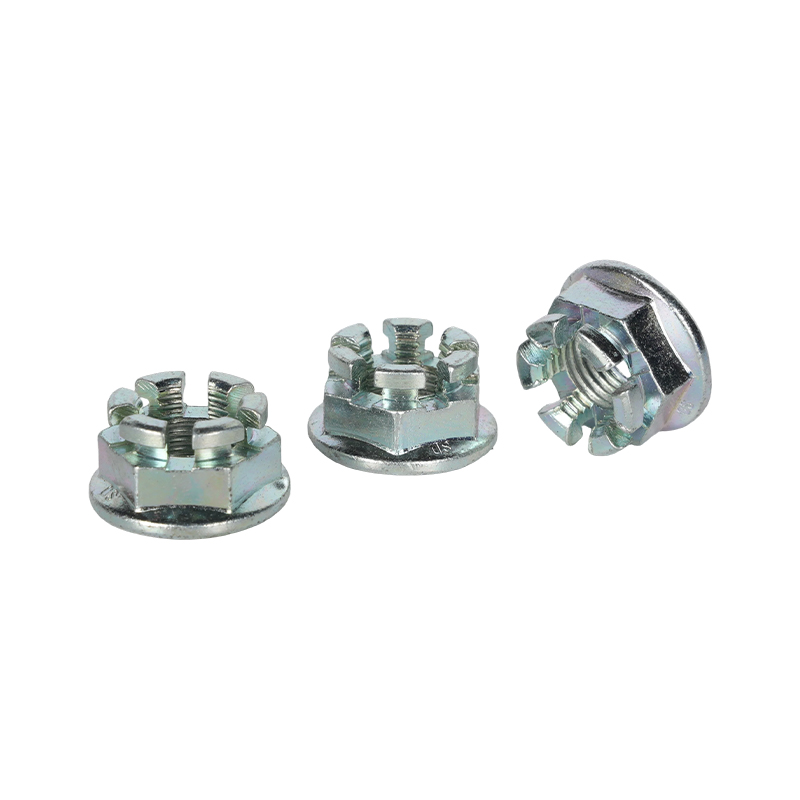
The listed catalogue item is the Carbon Steel Hex Flanged Slotted Nut, a hexagon body with an integrated bearing flange and castellations, used where washer retention and pin locking are both required. Tools, thread sizes, slot counts and flange geometry beyond that item are quoted against drawing through our Non-Standard Nuts capability, which runs on the same cold heading and tapping lines as the standard range.
- Body form: hexagon, hexagon with flange, cylindrical, or a drawing-specific outline
- Thread: metric coarse or fine pitch, unified threads, left-hand threads on request
- Castellation: number of slots, slot width and depth, radial or angled entry
- Bearing face: flat flange, chamfered, or with a controlled contact annulus
- Material and property class selected against the axial load and the mating stud
- Marking, surface finish and packaging specified per release
Application Fit Across Vehicle and Machine Assemblies
Slotted nuts suit joints that combine a drilled stud with a pin, especially where the nut must be locked at a specific angular position rather than at a fixed torque. Our automotive work is concentrated in wheel-end, chassis and interior structures, and the same nuts transfer directly to off-highway equipment, agricultural machinery and industrial drives.
- Axle and hub retaining positions locked by split pin
- Steering tie rod ends, ball joint studs and drag link pivots
- Suspension link pins and stabiliser connections
- Prop shaft, yoke and coupling joints subject to torsional cycling
- Seat frames, adjustment pivots and body mechanism pins
- Trailer, lifting and general mechanical assemblies with pin-locked fastening
Materials, Strength and Surface Performance
Material selection follows the property class and the environment. Carbon steel covers general chassis and body positions; alloy steel is used as strength rises; plating and temperature-resistant finishes follow the exposure of the joint. The control points below are those we define in the quotation for each slotted nut.
| Specification area | What we control | Why it matters in service |
|---|---|---|
| Property class | Volume production through Class 12; Class 13–14 pre-research | Higher axial load capacity for heavy-duty trucks and high-output engines |
| Dimensional tolerance | Bands from 0.06 mm to 0.30 mm, selected per feature | Consistent slot position, flange seating and assembly fit |
| Thread quality | Tapping and thread rolling in-house; MAT self-correcting first threads | Guides the stud into the correct thread path during automated assembly |
| Corrosion protection | Trivalent zinc at 480 h salt spray; Zn-Ni alloy at 480–720 h | Stable torque and appearance through road splash and wash cycles |
| Temperature grades | Finishes rated at 300 °C, 550 °C and 650–700 °C | Exhaust and engine-periphery joints that reach elevated temperatures |
| Verification | Raw material analysis through mechanical performance testing | Documented conformity for incoming inspection and line release |
Nut Families We Supply Alongside Slotted Nuts
Most slotted nut projects sit inside a broader fastener schedule. We quote the combined requirement so thread sizes, materials and coatings stay consistent across the assembly.
| Nut family | Typical configuration | Where it fits |
|---|---|---|
| Slotted Nuts | Hex or hex flanged body with castellations for a cotter pin | Pin-locked wheel-end, steering, suspension and linkage joints |
| Standard Nuts | Hex and flanged nuts to established dimensional standards | General clamping positions across chassis and body |
| Weld Nuts | Flanged, blind closed-end and projection-weld forms | Sheet-metal structures requiring a fixed threaded seat |
| Self-Locking Nuts | Prevailing-torque elements and interference thread forms | Vibration-loaded joints where no drilled stud is available |
| Knurled Nuts | Straight or double knurl, flanged cylindrical insert bodies | Moulded, pressed or insert applications needing grip and torque transfer |
| Clinch Nuts | Permanent press-fit into sheet material | Thin panels where access to both faces is restricted |
| Sliding Nuts | Captive sliding elements in a cage or channel | Adjustable brackets and rails with variable fixing positions |
Quality Control and Acceptance
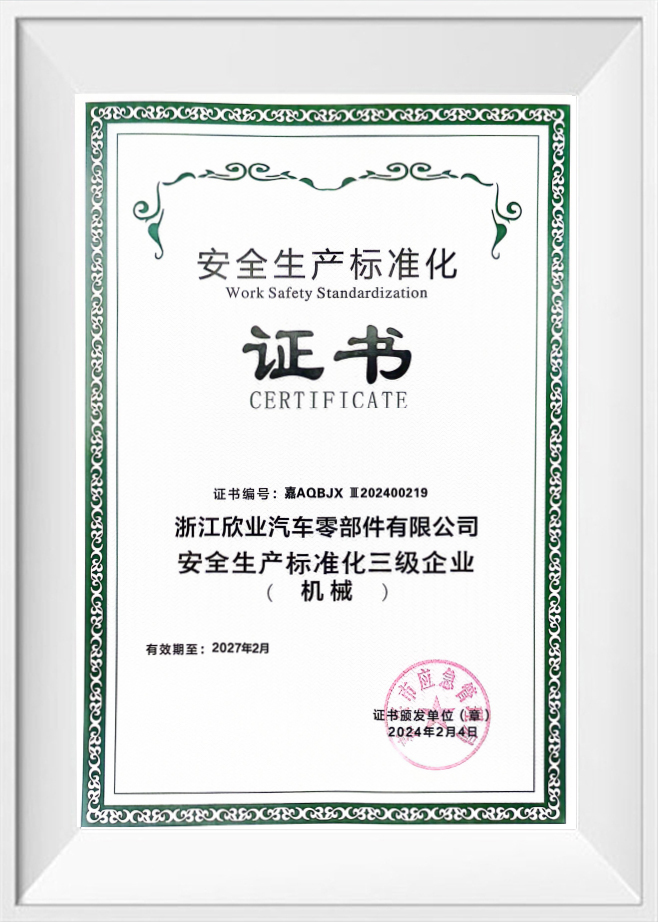
Our management system is certified to IATF 16949-2016, supported by an environmental management system certification and work safety standardisation certification. Work instructions are issued for special and critical processes such as heading, heat treatment and thread forming, and inspection is placed at each production step rather than only at final release.
- Incoming raw material analysis before coils enter the heading machines
- Dimensional and gauge checks on thread, across-flats, flange and slot features
- Hardness testing with in-house hardness testers after heat treatment
- Finished-part mechanical performance testing against the specified property class
- Coating verification against the agreed salt-spray target
- Visual inspection of castellation edges, marking and thread condition
Information We Use to Configure Your Solution
A slotted nut quotation is only as precise as the joint data behind it. These inputs let us fix the material, tooling, coating and inspection plan before pricing.
- Drawing or standard reference, including thread size, pitch and thread hand
- Property class and material grade, and the mating stud specification
- Castellation arrangement: slot count, width, depth and position relative to the drilled hole
- Flange or bearing-face geometry and the surface it seats against
- Coating system, salt-spray target and any operating temperature
- Annual volume, release frequency and container or packaging requirement
- Marking, labelling, documentation set and required language
- Assembly method — manual, pin-fed or automated press and driver tooling
Documentation, Packaging and Delivery Scope
Nuts are supplied bulk-packed or in ordered containers with the marking agreed at quotation, and shipped from Jiaxing Port Area with the inspection and material records for the released batch. Our engineering team supports drawing review before tooling is committed, and confirms the installation guidance for castellation alignment so the pin seats correctly at the specified torque. Slotted nuts are quoted together with the rest of the complete nuts range when a project spans several positions.
Frequently Asked Questions
When should a slotted nut be used instead of a self-locking nut?
Choose a slotted nut when the mating stud can be cross-drilled and the joint needs a lock that stays effective after preload relaxes, or where the nut must be locked at a particular angular position. Self-locking nuts suit joints without a drilled stud and rely on prevailing torque instead of a pin.
Can you produce slotted nuts to our own drawing rather than a catalogue item?
Yes. Custom bodies, slot arrangements, flange geometry, thread forms and coatings are quoted from drawing through our non-standard nut capability, using the same cold heading, tapping, thread rolling and heat treatment equipment as the standard slotted range.
Which strength classes can you deliver for slotted nuts?
Production has progressed from Class 5 and Class 8 to Class 12, and Class 13–14 ultra-high-strength nuts have completed pre-research. The class is confirmed against the axial load of the joint and the grade of the mating stud.
What coatings and corrosion performance do you offer?
Trivalent zinc plating tested to 480 h salt spray and Zn-Ni alloy plating tested to 480–720 h salt spray, all from our in-house surface finishing line. Temperature-resistant finishes are available in 300 °C, 550 °C and 650–700 °C grades for exhaust and engine-periphery positions.
How is slot-to-hole alignment handled at assembly?
Slot position is controlled during forming and checked as a dimensional feature, and the tightened nut should present a slot to the cross-drilled hole within the specified torque window. Where the window is tight, we review slot count, stud hole position and washer thickness with your engineering team before tooling release.
What leads a slotted nut quotation?
Drawing or standard reference, thread and property class, slot and flange geometry, coating and temperature, annual volume with release pattern, and the marking and documentation package. With those defined, we confirm tooling, inspection plan and delivery scope in the offer.
- Contact Us
-
-
861260628@qq.com

zj@xy-nuts.com -
+86 15888350558

-
No.350 Jingyi Road, Jiaxing Port Area, Zhejiang Province, China.

-
- Quick Links
- Products
- About Us
- Capabilities
- Service
- News
- Contact Us
- Product
- Nuts
- CNC Machined Components, Sleeves & Pins
- Specialty & Functional Automotive Components
- Metal Stampings
- Bolts & Screws
- Mobile
Copyright ©
Zhejiangxinye Automobile Technology Co. , Ltd.
All Rights Reserved
Custom
Slotted Nuts Suppliers
