

 Español
 عربى
product
product
product
product
product
product
product
product
product
product
product
product
product
product
product
product

Product Category
Contact us
Message Feedback
About Us
30 Years of Expertise in Automotive Fasteners
Zhejiangxinye Automobile Technology Co. , Ltd. traces its origins to 1995, evolving from Jiaxing Zhapu Xinye Standard Parts Co., Ltd. We are China Knurled Nuts Suppliers and Custom
Knurled Nuts factory. The company specializes in the production of various automotive fasteners and stamping parts, including flange nuts, welding nuts, and more. For over 30 years, Xinye has kept pace with industry trends, focusing on technological innovation and internal management, and has achieved steady growth. The company is now certified to IATF 16949-2016.
Adhering to the principle of "surviving by product quality, developing by technological innovation," Xinye takes quality as its foundation and customer satisfaction as a top priority, committed to providing suitable and reliable products. To enhance product competitiveness and strengthen employee quality awareness, the company has established a sound management system and standardized process flows. Work instructions have been developed for special and critical processes, and strict quality inspections are conducted at every step. From raw material analysis to finished product mechanical performance testing, process control is implemented to ensure product conformity. The continuously improving quality management system and stable product performance have earned the company market recognition, as well as customer trust and praise.
Adhering to the principle of "surviving by product quality, developing by technological innovation," Xinye takes quality as its foundation and customer satisfaction as a top priority, committed to providing suitable and reliable products. To enhance product competitiveness and strengthen employee quality awareness, the company has established a sound management system and standardized process flows. Work instructions have been developed for special and critical processes, and strict quality inspections are conducted at every step. From raw material analysis to finished product mechanical performance testing, process control is implemented to ensure product conformity. The continuously improving quality management system and stable product performance have earned the company market recognition, as well as customer trust and praise.
-
0m2
Factory Area
-
0
Brand Origin
-
0+
Product Range
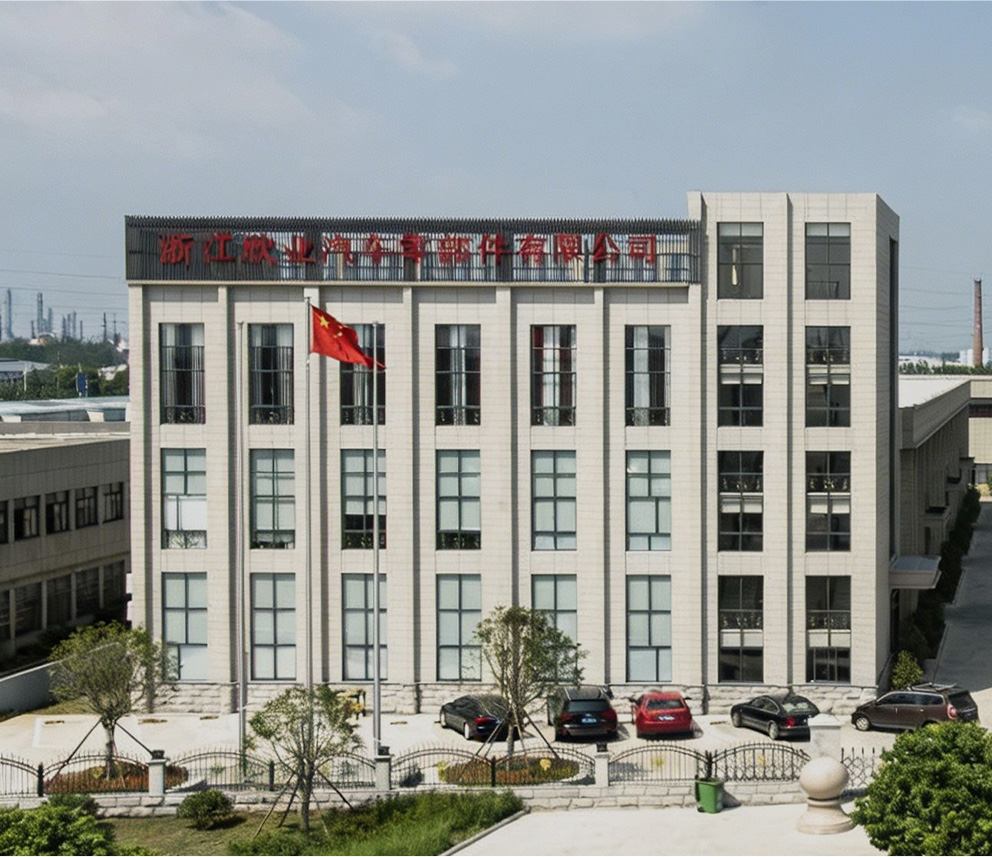

Zhejiangxinye Automobile Technology Co. , Ltd.
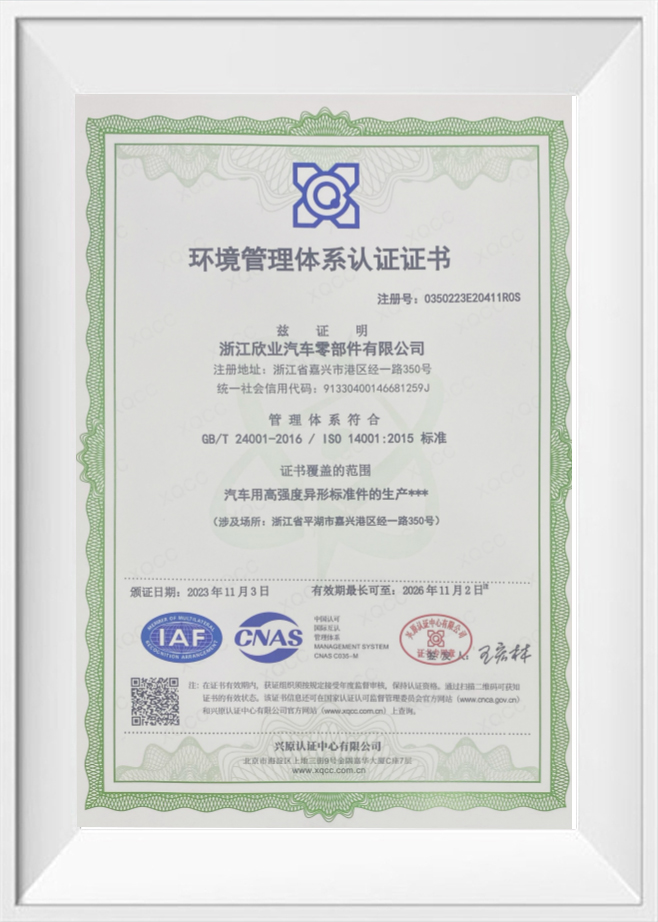
Certificate Of Honor
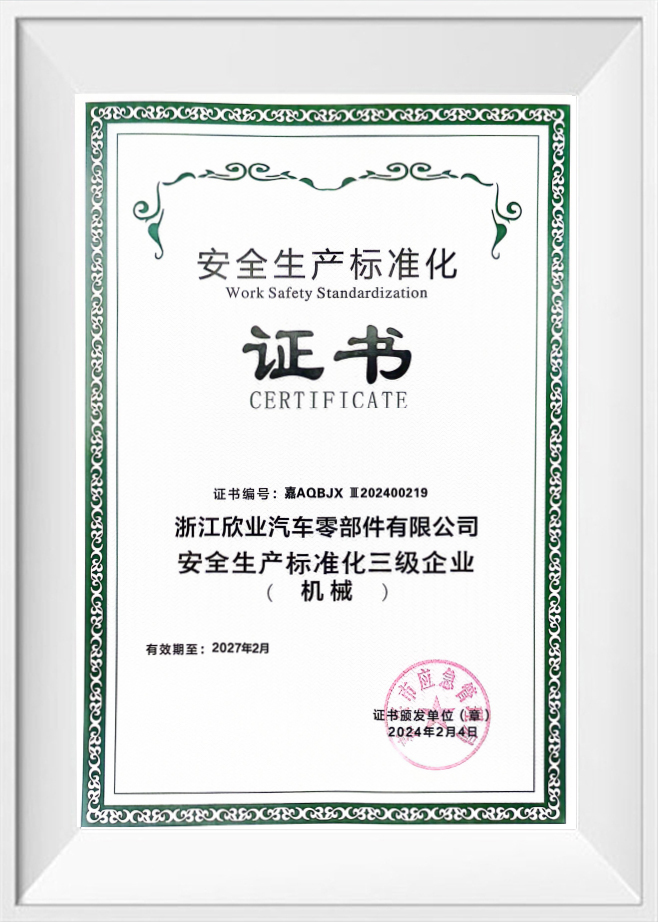
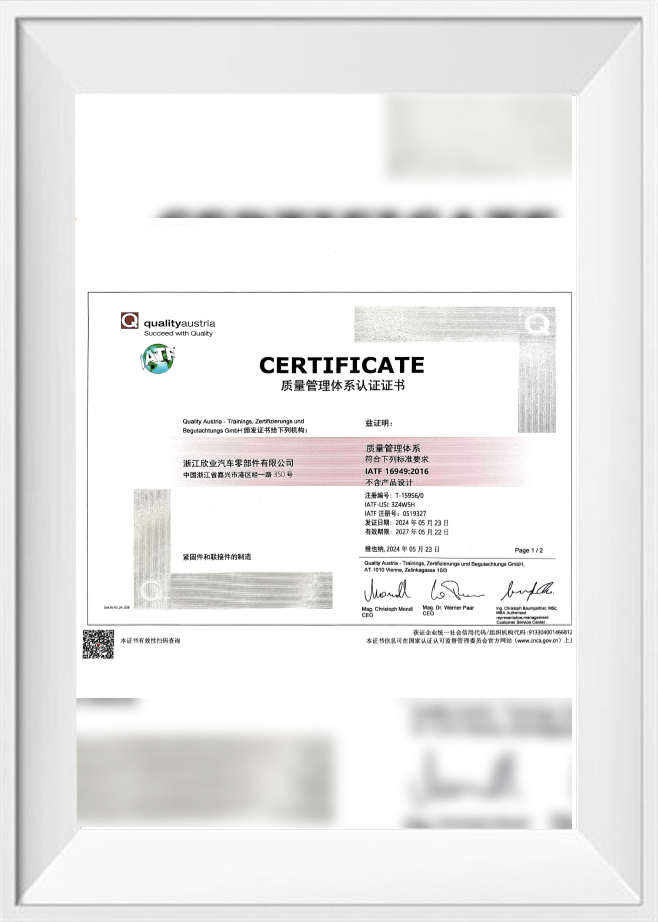
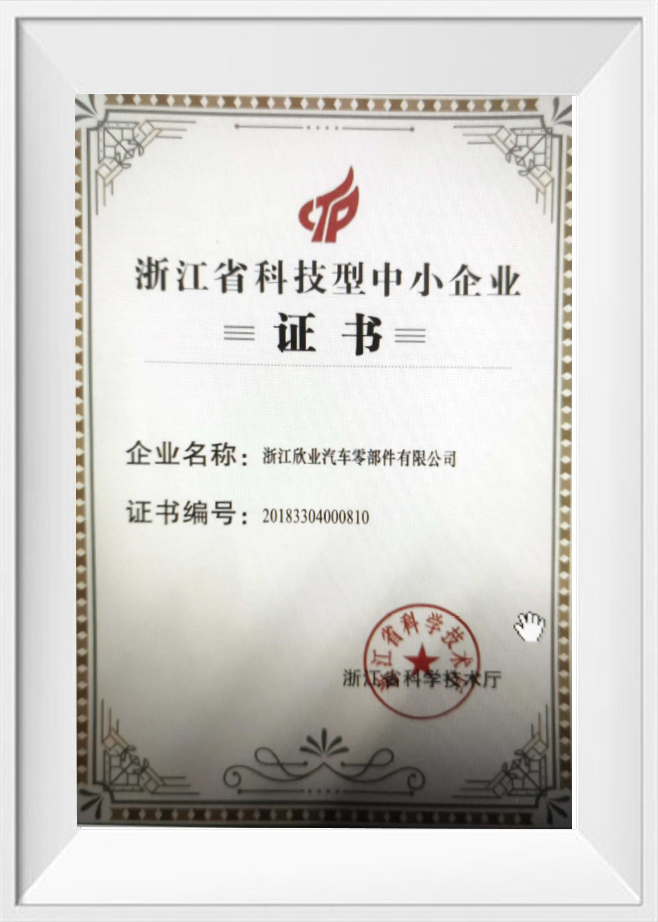
What’s News
Industry Insights & Updates
View All News
-
2026-11-03Industry News
-
2026-11-03Industry News
-
2026-11-03Industry News
Knurled Nuts Industry Knowledge
Zhejiangxinye Automobile Technology Co., Ltd. has manufactured automotive fasteners and stamping parts from our Jiaxing, Zhejiang base since 1995. Within that programme, knurled nuts are produced as press-fit and insert-moulding fasteners: cylindrical bodies with straight or diamond knurl, optional flanges, serrated bearing faces and closed or through-threaded ends. We are a China knurled nuts manufacturer supplying Tier 1 and Tier 2 automotive programmes, seat and interior assemblies, battery-pack hardware and general industrial equipment, with all production completed in-house from raw material to finished goods under an IATF 16949-2016 quality system.
The Custom Knurled Nuts Range We Supply
Our Custom Knurled Nuts Suppliers, Exporter range covers four production families, each built around a different retention method in the mating part. Knurl form, body diameter, flange presence and end closure are fixed by how the nut is anchored — moulded into a polymer, pressed into sheet metal or tightened against a serrated face under load.
| Product | Knurl and Body Form | Retention Method | Typical Application |
|---|---|---|---|
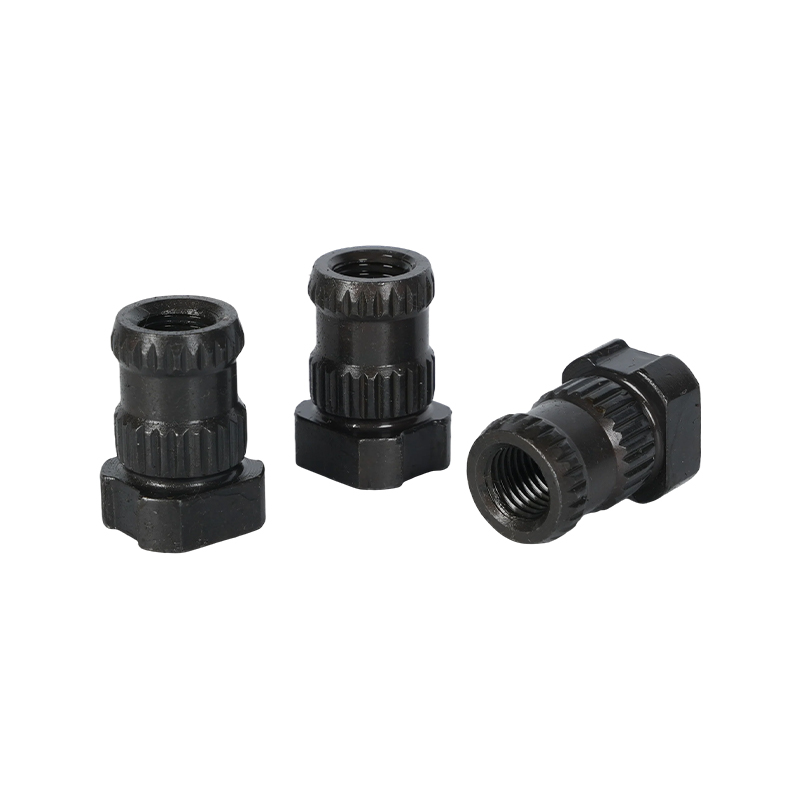
| Black Carbon Steel Knurled Serrated Nut | External knurl with serrated bearing face, black finish | Finger-tightened or torque-set grip nut | Adjustment points, brackets, trim and accessory fixing |
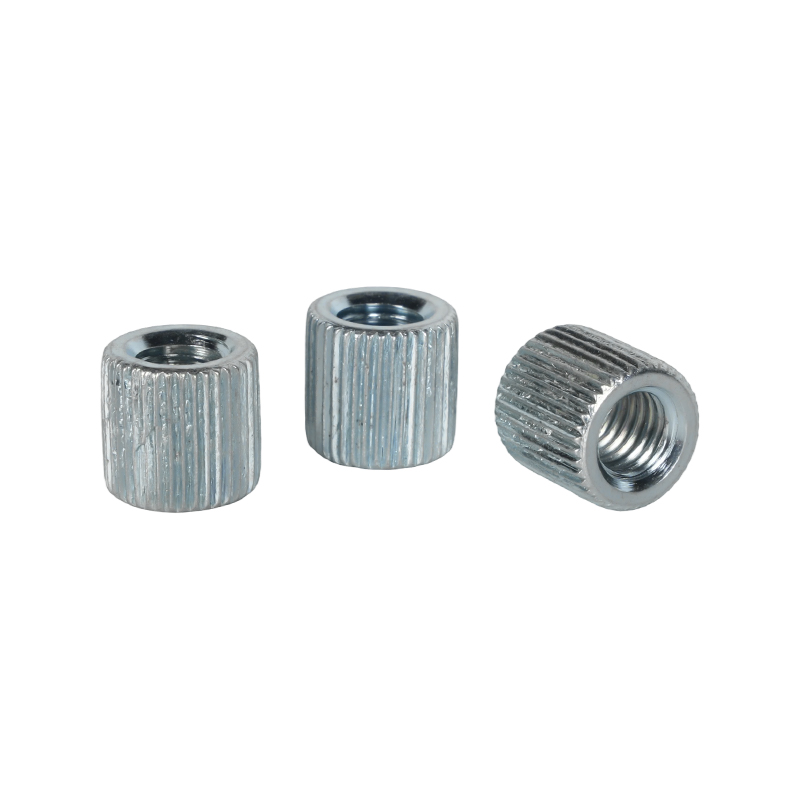
| Straight Knurl Cylindrical Insert Nut | Straight (parallel) knurl, plain cylindrical body | Press-fit into plastic or light-alloy housings | Interior trim, seat frames, moulded housings |
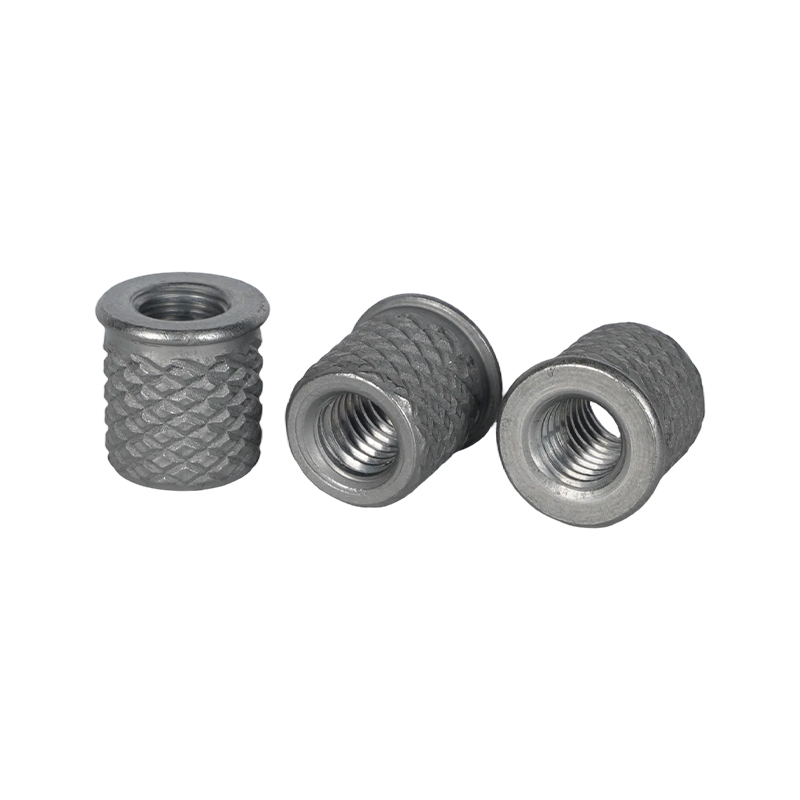
| Flanged Diamond Knurl Cylindrical Insert Nut | Diamond knurl body with load-spreading flange | Insert moulding or press-fit with flange seating | Structural plastic parts, panels, load-bearing joints |
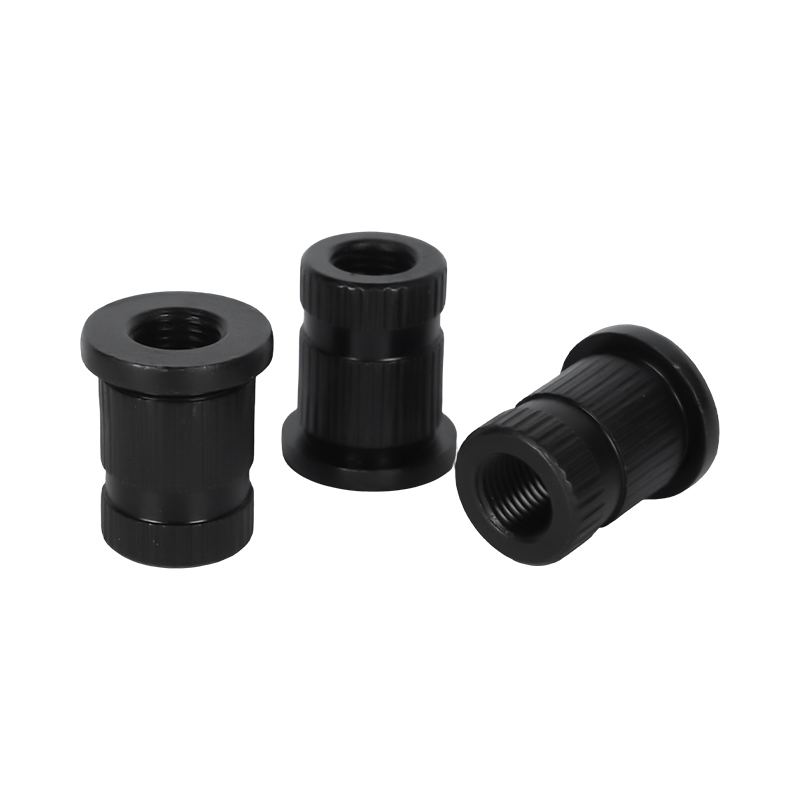
| Black Double Straight Knurl Flanged Cylindrical Insert Nut | Two straight knurl bands, flange, black surface | High pull-out resistance in moulded or pressed joints | Seat structures, battery-pack frames, chassis brackets |
Where a programme needs a different body diameter, knurl pitch or flange thickness, the same tooling logic is applied through our Non-Standard Nuts engineering route rather than being forced into a catalogue size. The wider nuts programme covers weld, clinch, self-locking, slotted and standard hex forms so that a single fastener package can be sourced together.
Where Knurled Nuts Fit in the Assembly
The knurl is a functional surface, not decoration. Its teeth cut or key into the mating material to resist rotation under torque and to carry pull-out load, which is why knurled nuts appear wherever a threaded insert must survive vibration without a separate locking feature.
- Moulded-in inserts: straight or diamond knurl resists rotation inside glass-filled PA, PBT or PP mouldings during bolt tightening.
- Press-fit joints: controlled knurl diameter holds the nut in sheet metal or die-cast housings before the mating screw is introduced.
- Serrated grip nuts: the serrated face bites into the clamped part to prevent loosening on brackets and adjustment points.
- Blind or closed-end variants: used where the thread must be protected from moisture, sealant or potting compound.
Knurl Geometry, Flange Form and Grip
We set the knurl configuration against the mating material and the assembly method. Diameter over knurl, knurl angle, tooth depth and the transition to the flange all affect insertion force, hole fill and the torque the joint can accept.
- Straight knurl — axial teeth for press-fit and moulded insertion, where the nut is pushed or moulded in along the axis.
- Diamond knurl — crossed teeth that resist both rotation and axial pull-out in moulded joints.
- Double straight knurl — two knurl bands increase the keyed area for higher pull-out loads in thicker sections.
- Flange — spreads clamping load, provides a seating face and controls insertion depth against the mould or panel surface.
- Serrated face — hardened teeth under the head for anti-loosening on bolted assemblies.
Materials, Strength Class and Surface Performance
Knurled nuts are produced in carbon steel and, where the application calls for it, in alloy and stainless grades. Property class is agreed against the torque and axial load of the joint — our production development has moved from early Class 5 and 8 parts to Class 12, with Class 13–14 ultra-high-strength nut research already completed for heavy-duty and high-performance applications.
| Surface Condition | Corrosion / Temperature | Where We Recommend It |
|---|---|---|
| Trivalent zinc plating | Up to 480 h salt spray | Interior and under-body fasteners, general trim |
| Zn-Ni alloy plating | 480–720 h salt spray | Chassis, battery-pack and exposed hardware |
| Black oxide / black coated | Appearance and light protection | Visible interior parts, adjustment knobs |
| Heat-resistant grades | 300 °C, 550 °C, 650–700 °C | Exhaust systems and engine-periphery joints |
Surface finishing is developed in-house, so coating thickness, hydrogen-embrittlement control for high-strength parts and the salt-spray target are agreed as part of the drawing rather than added afterwards.
Thread Fit, Tolerances and Assembly Behaviour
Thread fit precision is controlled across a 0.06 mm to 0.30 mm working band depending on application, which allows us to hold a free-running fit on manual assembly and a tighter, anti-loosening fit on automated lines. Our MAT self-correcting thread design forms the first few threads so that a slightly misaligned screw is guided back into the correct thread path instead of cross-threading.
- Thread size, pitch and class stated on the drawing, with gauge verification at production.
- Knurl diameter over teeth toleranced separately from the body diameter to fix insertion force.
- Flange thickness, outer diameter and squareness to control seating in the mould or panel.
- Concentricity between thread axis and knurled body for automated pick-and-place feeding.
- Runout and burr limits at the knurl ends to protect operator handling and feeder tooling.
Quality Control from Raw Material to Mechanical Test
We operate a documented, standardized process flow with written work instructions for special and critical operations. Inspection is applied at every step rather than only at final release, and the results form the acceptance record for each production lot.
- Incoming raw material analysis, including grade and chemical composition verification.
- In-process checks after cold heading, tapping, thread rolling and heat treatment.
- Hardness testing on heat-treated parts, with case depth control on case-hardened items.
- Finished-product mechanical performance testing — proof load, torque and pull-out resistance.
- Coating thickness and salt-spray verification on plated lots.
- IATF 16949-2016 certified quality management system, supported by environmental management and work-safety certification.
Insert Moulding and Press-Fit Installation Notes
Knurled nut performance is decided as much by the installation as by the part. We confirm the joint design data with the customer before tooling release, because gate position, boss wall thickness and hole diameter determine whether the knurl fills cleanly or shears the polymer.
- Boss or hole diameter and tolerance, plus the material grade and glass-fibre content of the moulding.
- Insertion method — ultrasonic, thermal, press-fit or moulded-in — and the resulting insertion force window.
- Recommended hole depth against nut length so the flange seats without bottoming out.
- Assembly torque range and the mating screw class, checked against the pull-out requirement.
- Handling and orientation requirements for automated bowl feeding or robotic placement.
Information We Use to Configure Your Solution
A proposal is prepared from the working point of the joint, not from a size alone. Providing the following lets us return a defined part, tooling position and inspection plan in a single step.
- Drawing or 3D model, including knurl type, body diameter, thread size and flange dimensions.
- Material and property class, plus any heat-treatment requirement.
- Surface finish and salt-spray target, with appearance requirements for visible parts.
- Annual and release quantity, pack size and container preference.
- Mating component details — screw class, boss or hole diameter, panel thickness and material.
- Assembly method and torque, with any pull-out or proof-load acceptance value.
- Inspection and documentation level, including sample submission and PPAP expectations.
- Labelling, barcode and delivery scope for the destination plant.
Documentation, Packaging and Delivery Scope
Lots are supplied with the inspection records agreed at order confirmation, and critical characteristics are linked to the drawing revision. Packaging is specified to protect knurl teeth and plating during transit — bulk cartons, layered trays or dunnage-separated boxes — with labels matched to the receiving plant's identification standard. Reorder quantities run against the same tooling and process route, so the part shipped in series production is the part validated at sample approval.
Knurled Nut Questions Answered by the Manufacturer
Can you produce knurled nuts to our drawing rather than a catalogue size?
Yes. Most knurled nut programmes we run are drawing-specific. We take the knurl type, body diameter, thread class, flange form, material and coating from your drawing, confirm the tooling approach, and supply samples for fit and pull-out verification before series release.
What is the difference between straight and diamond knurl for insert nuts?
Straight knurl provides axial teeth that resist rotation during tightening and suits press-fit and moulded-in joints. Diamond knurl crosses the teeth so the nut resists both rotation and axial pull-out, which is preferred in structural mouldings and thicker sections. Double straight knurl increases keyed area further where pull-out load is the governing requirement.
Which strength classes and coatings can you supply?
Production covers property classes from 5 and 8 through Class 12, with Class 13–14 ultra-high-strength development already validated in pre-research for heavy-duty and high-performance applications. Coatings include trivalent zinc at up to 480 hours salt spray, Zn-Ni alloy at 480–720 hours, and black finishes for visible parts.
How do you prevent cross-threading on automated assembly lines?
Our MAT self-correcting thread forms the leading threads so that a small misalignment between bolt and nut is corrected as the fastener engages. This reduces line stoppages and rework on automated driving stations, and it is specified together with the thread class and gauge requirement on the drawing.
Which quality system governs knurled nut production?
Production runs under an IATF 16949-2016 certified automotive quality management system, with documented work instructions for special and critical processes, raw material analysis, in-process inspection, hardness and mechanical performance testing, and coating verification on finished lots.
What lead information do you need for a first quotation?
Send the drawing or model, material and property class, coating and salt-spray target, annual and release quantities, mating component details, assembly torque and the required documentation level. With those we define the knurl configuration, tooling position and inspection plan, and return a configured quotation.
Related Products and Categories
Our portfolio also includes Black Carbon Steel Knurled Serrated Nut for applications with different operating ranges, interfaces or integration requirements.
- Contact Us
-
-
861260628@qq.com

zj@xy-nuts.com -
+86 15888350558

-
No.350 Jingyi Road, Jiaxing Port Area, Zhejiang Province, China.

-
- Quick Links
- Products
- About Us
- Capabilities
- Service
- News
- Contact Us
- Product
- Nuts
- CNC Machined Components, Sleeves & Pins
- Specialty & Functional Automotive Components
- Metal Stampings
- Bolts & Screws
- Mobile
Copyright ©
Zhejiangxinye Automobile Technology Co. , Ltd.
All Rights Reserved
Custom
Knurled Nuts Suppliers
