

 Español
 عربى
Automotive Bolts and Nuts for EV Manufacturing: Battery Pack and Assembly Fastening Automotive Bolts and Nuts for EV Manufacturing: Battery Pack and Assembly Fastening Automotive Bolts and Nuts for EV Manufacturing: Battery Pack and Assembly Fastening Automotive Bolts and Nuts for EV Manufacturing: Battery Pack and Assembly Fastening Automotive Bolts and Nuts for EV Manufacturing: Battery Pack and Assembly Fastening Automotive Bolts and Nuts for EV Manufacturing: Battery Pack and Assembly Fastening Automotive Bolts and Nuts for EV Manufacturing: Battery Pack and Assembly Fastening Automotive Bolts and Nuts for EV Manufacturing: Battery Pack and Assembly Fastening Automotive Bolts and Nuts for EV Manufacturing: Battery Pack and Assembly Fastening Automotive Bolts and Nuts for EV Manufacturing: Battery Pack and Assembly Fastening Automotive Bolts and Nuts for EV Manufacturing: Battery Pack and Assembly Fastening Automotive Bolts and Nuts for EV Manufacturing: Battery Pack and Assembly Fastening Automotive Bolts and Nuts for EV Manufacturing: Battery Pack and Assembly Fastening Automotive Bolts and Nuts for EV Manufacturing: Battery Pack and Assembly Fastening Automotive Bolts and Nuts for EV Manufacturing: Battery Pack and Assembly Fastening Automotive Bolts and Nuts for EV Manufacturing: Battery Pack and Assembly Fastening

Product Category
NEW Category
Contact us
Automotive Bolts and Nuts for EV Manufacturing: Battery Pack and Assembly Fastening
A traction battery pack is built around several hundred threaded joints, and each one is a structural connection, a sealing interface and a traceability record at the same time. EV programs freeze fastener specifications earlier than body-in-white specifications because the requirement comes from the pack's IP class, its vibration profile and its high-voltage safety case, not from a generic mechanical drawing.
Since 1995Manufacturing origin of Zhejiangxinye Automobile Technology Co., Ltd.
IATF 16949:2016Quality management system certification held by the plant
ISO 898-1Property classes 8.8, 10.9 and 12.9 for steel bolts
IP6K9KHigh-pressure jet protection class defined in ISO 20653
The four decisions that actually move a program are sealing geometry, clamp load retention, joint positioning at body-in-white, and the lot evidence a buyer signs off before the first production shipment.
How EV Fastening Requirements Differ From Combustion Vehicles
EV fasteners are specified by three loads that combustion vehicles do not combine: a sealed high-voltage enclosure, a pack that can weigh several hundred kilograms, and a body structure that mixes aluminium with steel fasteners.
On a combustion platform most fastener data is mechanical: thread size, property class, coating. On an EV platform that data is the starting point only. The pack adds an electrical safety case, a protection class and a thermal cycle count, and each of those turns a standard part into a validated system interface.
Definition: a pack-grade fastener is a threaded or welded joint whose failure mode is defined on the drawing, whose clamp load is validated against a tightening torque window, and whose production lot is traceable to the pack serial number.
- Sealing belongs to the joint, not to the gasket: the thread bore is an open path unless the nut is closed-ended or the weld is continuous.
- Clamp load is a safety variable: contact resistance at a module terminal or busbar rises as soon as preload is lost.
- The material mix drives the damage: a steel fastener in an aluminium housing forms a galvanic couple and adds two different expansion rates to the same joint.
Battery Pack Fastening: Sealing, Clamp Load and Protection Class
A battery-pack fastener either holds the pack's IP rating or breaks it, so sealing has to be built into the joint geometry rather than added around it.
The practical answer is closed geometry. Blind and closed-end nuts keep the bore sealed on the far side of a panel, and spot-weld versions close the end and spread weld current in one part. Where the enclosure is aluminium, weld continuity replaces gasket compression as the primary seal, and the nut becomes part of the enclosure wall rather than a fitting on top of it.
| Requirement | What the joint must deliver | Verification route |
| Sealing | Closed-end nut geometry or a continuous weld, so the thread bore is not an open path | Pack-level IP test to ISO 20653, helium leak test |
| Clamp load | A torque window derived from a VDI 2230 Part 1 calculation and confirmed on the delivered lot | ISO 16047 torque-tension test, residual torque audit |
| Vibration | Prevailing-torque element or thread adhesive where the joint cannot be retightened | Vibration sequence in UN ECE R100 Part II |
| Corrosion | Zinc flake or zinc-nickel coating with a controlled friction coefficient | Cyclic corrosion test, friction coefficient check |
| Thermal cycling | Preload retention from -40 °C to +85 °C without relaxation in the aluminium housing | Thermal shock sequence in UN ECE R100 Part II |
The sealing nut family is where these requirements meet in one part: a flanged closed-end nut with a locating tab positions itself, closes the bore and accepts a weld or a threaded joint in the same operation.
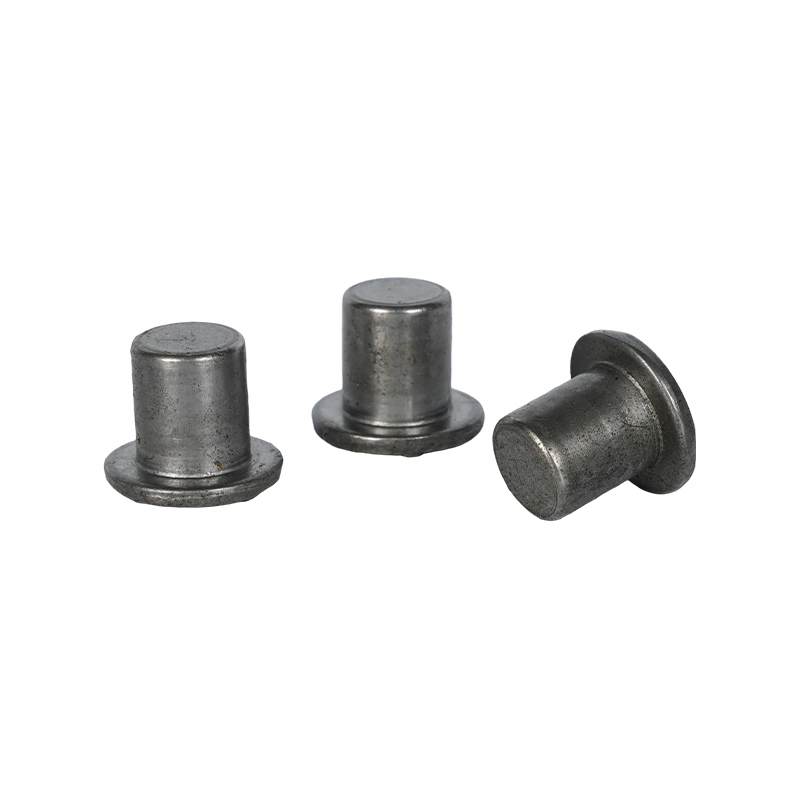 Flanged Blind Closed-End Waterproof Nut for Battery PacksSingle-side-installed sealed nut with flanged head and closed-end barrel for watertight threaded connections in EV battery pack enclosures.View Product →
Pack validation sits on top of component testing. GB 38031-2020 requires a thermal event warning before propagation produces a hazard in the occupant compartment, and any joint that loosens inside the enclosure works against that requirement long before a test rig sees it.
Body, Seat and Wheel Joints in Vehicle Assembly
Outside the pack, EV assembly splits into welded joints made in body-in-white and threaded joints made at final assembly, and the two need different fastener families and different drawings.
Welded joints in body-in-white
- Projection weld nuts and weld spacers carry their own locating tabs, so the part positions itself before the weld cycle.
- Square and round weld spacers set mounting height for seat frames and body brackets; their length tolerance sets the gap at final assembly, not the bolt.
- Weld quality is verified by push-out or torque-to-failure on coupons taken from the same welding setup used in production.
Threaded joints at final assembly
- Cage and floating nuts provide radial float that absorbs accumulated stamping tolerance, so the bolt engages at line speed without reaming.
- Hex bolts with an integrated flat washer remove a loose part from the station and keep the bearing face friction repeatable.
- Wheel nuts are a separate family: one-piece cap type or open-end taper seat, with seat angle and torque fixed by the vehicle manufacturer.
Seat structures add a third case. Seat frames use weld nuts, spacer sleeves and hinge shaft nuts where the joint must both position a moving part and hold a specified running clearance after assembly, which is why seat fasteners are usually non-standard parts with a defined flatness and a defined mounting face.
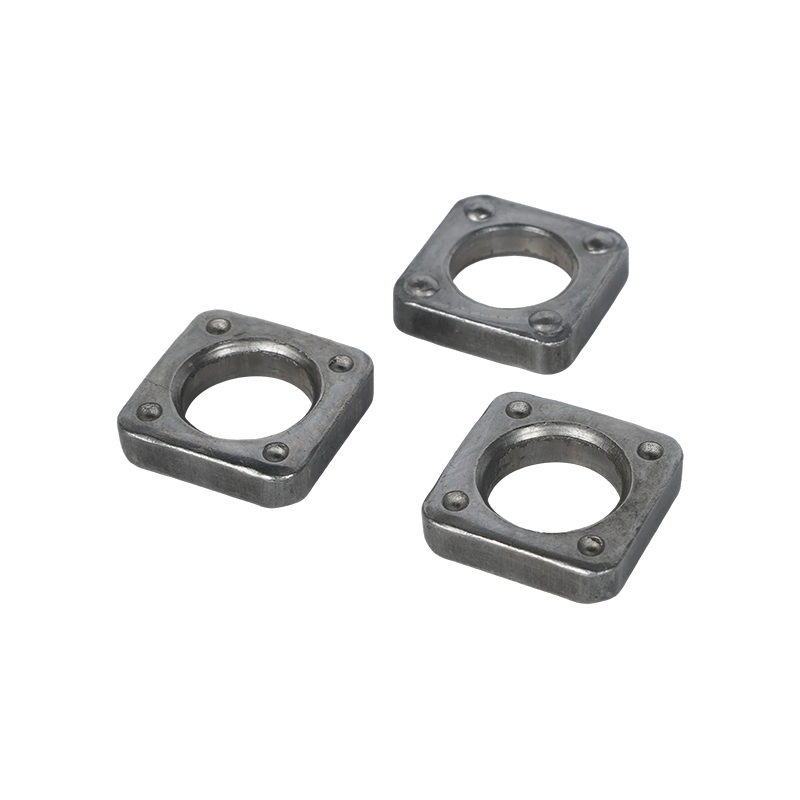 Square Weld Spacer for Vehicle Body and Seat AssembliesWeldable square spacer with central clearance hole that sets a defined standoff and resists rotation during tightening in body and seat build assemblies.View Product →
Wheel fastening deserves its own note: a wheel nut has to survive repeated removal without losing seat geometry, and a cap-type nut also has to keep the stud end and thread protected from road exposure.
Material and Coating Choices That Decide Field Life
The default EV joint is a steel fastener in an aluminium housing, which makes coating selection a corrosion decision rather than a finish choice.
In that couple aluminium is the anode, so the housing corrodes first and the failure appears as a white deposit and a loose joint rather than a rusty bolt. Coated steel fasteners limit the potential difference. Stainless fasteners make it worse, because stainless steel is cathodic to aluminium and pushes the whole corrosion load onto the housing.
| Coating system | Standard | Best fit | Risk to control |
| Zinc flake | ISO 10683 | Aluminium housings, Cr(VI)-free programmes | Friction coefficient shifts with lubricant; confirm by torque-tension test |
| Zinc-nickel electroplated | ISO 4042 | Higher corrosion demand at controlled thickness | Hydrogen embrittlement above class 10.9; verify to ISO 15330 |
| Stainless A2 and A4 | ISO 3506-1, ISO 3506-2 | Interior trim and low-load joints | Cathodic to aluminium; housing corrodes where isolation is weak |
| Phosphate and oil | No coating standard claimed | Dry interior joints only | No protection in humid or salt exposure |
Hydrogen embrittlement is the second trap. Electroplated class 10.9 and 12.9 fasteners can absorb hydrogen during pickling and plating, and the failure appears days after assembly at loads below the proof load. ISO 15330 defines a preloading test for detecting it, while baking and zinc flake or mechanical coating are the usual routes out.
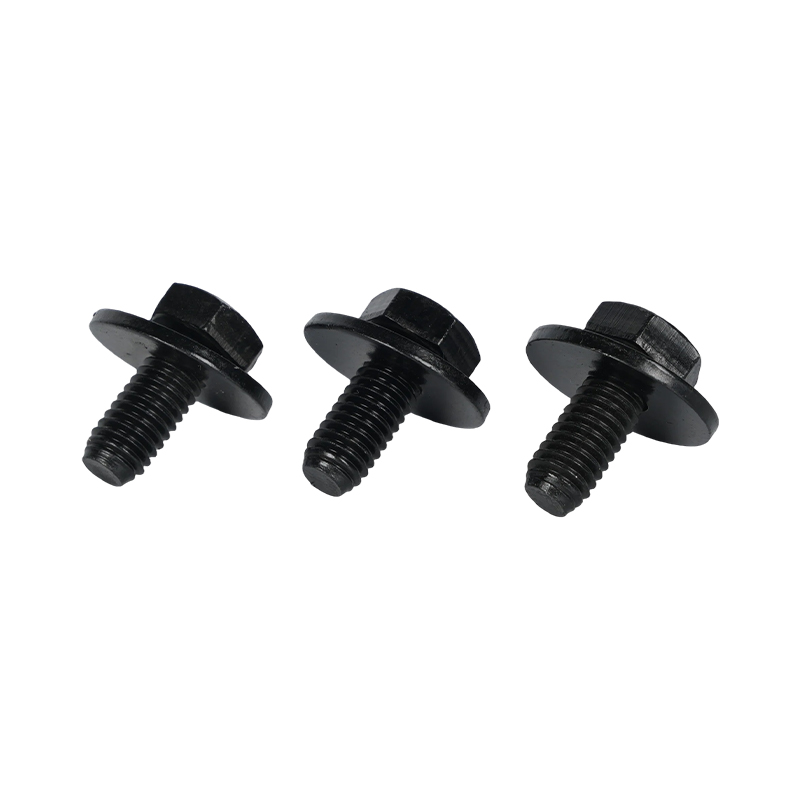 Black Hex Head Bolt with Integrated Flat WasherOne-piece hex bolt and captive washer that distributes clamp load and cuts loose-part handling; black surface treatment adds a corrosion-resistant barrier.View Product →
Friction control is what makes a torque window valid. The engineering rule of thumb is that under-head friction takes roughly 50 percent of the applied torque and thread friction about 40 percent, leaving around 10 percent to become clamp load, so a coating change alters the delivered preload even when the drawing torque is unchanged.
What a Pack Program Audits Before Approving a Lot
An EV fastener supplier is approved on process control and lot traceability, not on the certificate alone.
IATF 16949:2016 sets the framework: APQP for development, PPAP for the approval file, and MSA and SPC for the measurement and process data behind it. Zhejiangxinye Automobile Technology Co., Ltd. holds that certification and controls the sequence from raw material analysis through finished mechanical property testing, which is the minimum a pack program will check on site.
- Which heat lot sits in which shipment, and can it be traced back from the pack serial number?
- Is the torque window supported by an ISO 16047 torque-tension test on the delivered coating and lubricant?
- Are weld nuts validated by push-out or torque-to-failure on the same projection welding setup used in series production?
- Is the corrosion report cyclic rather than a single salt spray figure taken from a development sample?
Buyer check: ask for the quality control process documents that sit behind the certificate, not the certificate itself. A PPAP file that names the friction coefficient, the welding setup and the heat lot is worth more than a page of test results without a traceable origin.
What to Put on the Drawing Before Release
A release-ready drawing for an EV fastener carries eight items, and every missing one shifts risk to the assembly line.
- Property class per ISO 898-1 for the bolt and the matching nut class per ISO 898-2, with the design intent that an overload fails in the bolt rather than in thread stripping.
- Thread tolerance, plus weld projection geometry and locating tab position for weld nuts and weld spacers.
- Coating system with its standard, thickness range and friction coefficient window.
- Sealing requirement written as a test outcome: IP class per ISO 20653 plus an acceptable leak rate.
- Tightening torque range with its calculation basis, normally VDI 2230 Part 1.
- Hydrogen embrittlement controls for class 10.9 and above, with the specified test method.
- Material certificate grade and lot marking requirement on the part or the packaging.
- Validation tests with sample size and acceptance criteria, agreed before tooling starts.
Fastener cost is a small share of a pack bill of materials; a single unsealed enclosure joint that fails end-of-line leak testing is not. Specify the joint outcome, then let the part geometry follow it.
Questions Buyers Ask Before Releasing a Fastener Drawing
What torque should a battery pack cover bolt use?
There is no universal figure. Torque follows thread size, friction coefficient and the preload the joint needs; VDI 2230 Part 1 gives the calculation route and ISO 16047 confirms the real torque-tension relationship on the delivered lot. Two suppliers using different lubricants need different torque windows for an identical bolt.
Are prevailing-torque nuts needed inside the pack?
Not at every position. Use them where the joint cannot be retightened and where thermal cycling is high, such as module frames and busbar connections. ISO 7040 and ISO 7042 define two prevailing-torque nut styles; the second style carries the higher proof load and suits higher bolt classes.
How do weld nuts and clinch nuts differ in body assembly?
Weld nuts are joined by projection welding and suit steel and aluminium structures that accept a weld cycle. Clinch nuts are pressed into sheet and suit aluminium and coated panels where a weld would damage the surface or the heat treatment.
Which documents should travel with a battery pack fastener lot?
At minimum an EN 10204 3.1 material certificate, a dimensional report, a mechanical property report to ISO 898-1 and ISO 898-2, a coating thickness and corrosion report, friction coefficient data, and heat lot traceability back to the shipment.
A pack program signs off on evidence, not on parts. The suppliers who stay on the program are the ones who can answer a heat lot question from a pack serial number in one working day.
PREV:Custom Car Screw Fasteners: Surface Treatments, Tolerances and OEM Production Checks
NEXT:Car Screw Fasteners: How to Select Thread Types, Dimensions and Coatings
NEXT:Car Screw Fasteners: How to Select Thread Types, Dimensions and Coatings
Interested in cooperation or have questions?
Recommended NEWS:
Automotive Bolts and Nuts: Material Grades, Strength Classes and Coating Specs
Automotive Fastener & Stamping Parts: Manufacturing Processes and Quality Control
Automotive Fastener and Stamping Parts Supplier: Bulk Order Checks for B2B Buyers
Car Screw Fasteners: How to Select Thread Types, Dimensions and Coatings
Custom Car Screw Fasteners: Surface Treatments, Tolerances and OEM Production Checks
Recommended LINkS:
Featured Products
Automobile Fasteners Solutions
- Contact Us
-
-
861260628@qq.com

zj@xy-nuts.com -
+86 15888350558

-
No.350 Jingyi Road, Jiaxing Port Area, Zhejiang Province, China.

-
- Quick Links
- Products
- About Us
- Capabilities
- Service
- News
- Contact Us
- Product
- Nuts
- CNC Machined Components, Sleeves & Pins
- Specialty & Functional Automotive Components
- Metal Stampings
- Bolts & Screws
- Mobile
Copyright ©
Zhejiangxinye Automobile Technology Co. , Ltd.
All Rights Reserved
Custom Automotive Fastener & Stamping Parts & Nuts & Bolts & Screws
